MOZART Scientific Publication: DLP-Printable Porous Cryogels for 3D Soft Tactile Sensing
IIT’s breakthrough in soft robotics introduces customizable porous materials designed for advanced tactile sensing applications.
Published on February 14, 2024, the article reflects IIT’s extensive contributions to the MOZART project throughout 2023. Garnering over 500 views already, it underscores the significant potential of customizable sensors for advanced technological systems.
The article in a nutshell
The publication marks a major advancement in the development of soft, conductive, and porous materials for cutting-edge applications. It introduces innovative methods to create flexible sensors using Digital Light Processing (DLP) 3D printing technology.
The research presents a new class of cryogels—materials that combine softness, flexibility, and electrical conductivity with a highly tunable porous structure. These unique properties make cryogels ideal for tactile sensing devices, where adaptability to mechanical stimuli and high sensitivity are essential. Leveraging DLP technology allows these materials to be precisely customized, enabling tailored solutions for specific use cases.
By merging DLP 3D printing with advanced cryogel chemistry, the study offers a versatile platform for designing materials that bridge the gap between flexibility, precision, and performance—opening the door to next-generation applications in robotics and beyond.
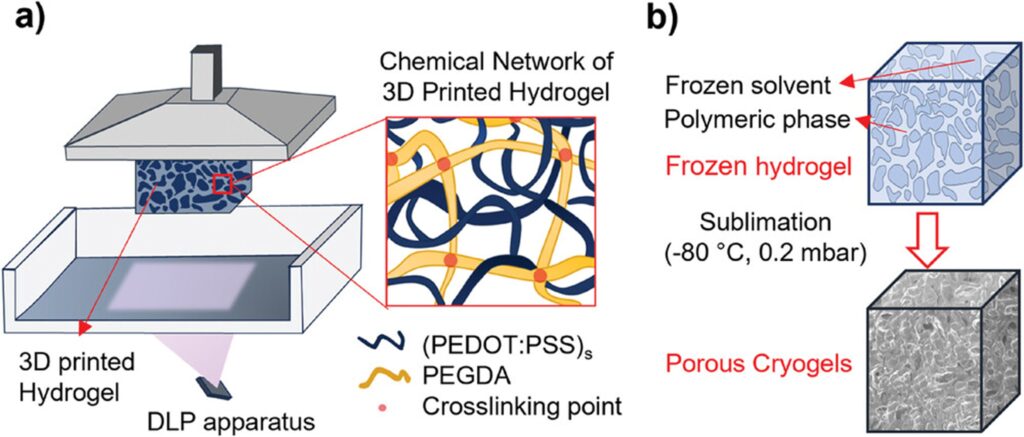
Scheme of the fabrication protocol for the 3D porous cryogels. a) The hydrogels were 3D-printed via DLP. During the printing, the formation of chemical cross-links between the polymer chains resulted in the formation of cured hydrogels. b) The printed hydrogels were frozen and then lyophilized in order to remove the ice crystals and form porous, dehydrated cryogels.
The relevance within MOZART
As part of the MOZART project, this breakthrough supports the development of highly responsive pore-elastic layers. These flexible, porous layers are capable of adapting to mechanical stresses, with applications spanning wearable electronics, robotics, and human-machine interfaces.
The ability to fine-tune both mechanical and conductive properties represents a significant leap forward in soft robotics and sensing technologies, reinforcing the MOZART project’s mission to pioneer innovations in this field.
Read the full article:
Citation:
Cafiso, D., Bernabei, F., Preti, M. L., Lantean, S., Roppolo, I., Pirri, C. F., & Beccai, L. (2024). DLP-Printable Porous Cryogels for 3D Soft Tactile Sensing. Advanced Materials Technologies, 9(10), 2302041. https://doi.org/10.1002/admt.202302041