
IIT’s soft sensing innovation shines at RoboSoft in Kanazawa
Two poster presentations showcase MOZART’s research on intelligent robot manipulation.
From April 7-11, the Japanese city of Kanazawa hosted RoboSoft 2026, a premier conference on soft robotics. The MOZART project partner IIT made a significant mark with relevant research on soft sensing for robot manipulation – work that earned recognition at both the main conference and a specialised workshop.
On April 10, Gayatri Indukumar presented the poster titled “Surface-based Manipulation Using Tunable Compliant Porous-Elastic Soft Sensing“, developed with Lucia Beccai, Muhammad Awais, Diana Cafiso and Matteo Lo Preti. The poster was recognized as one of the conference’s top three best poster finalists, a testament to the originality and relevance of the research.
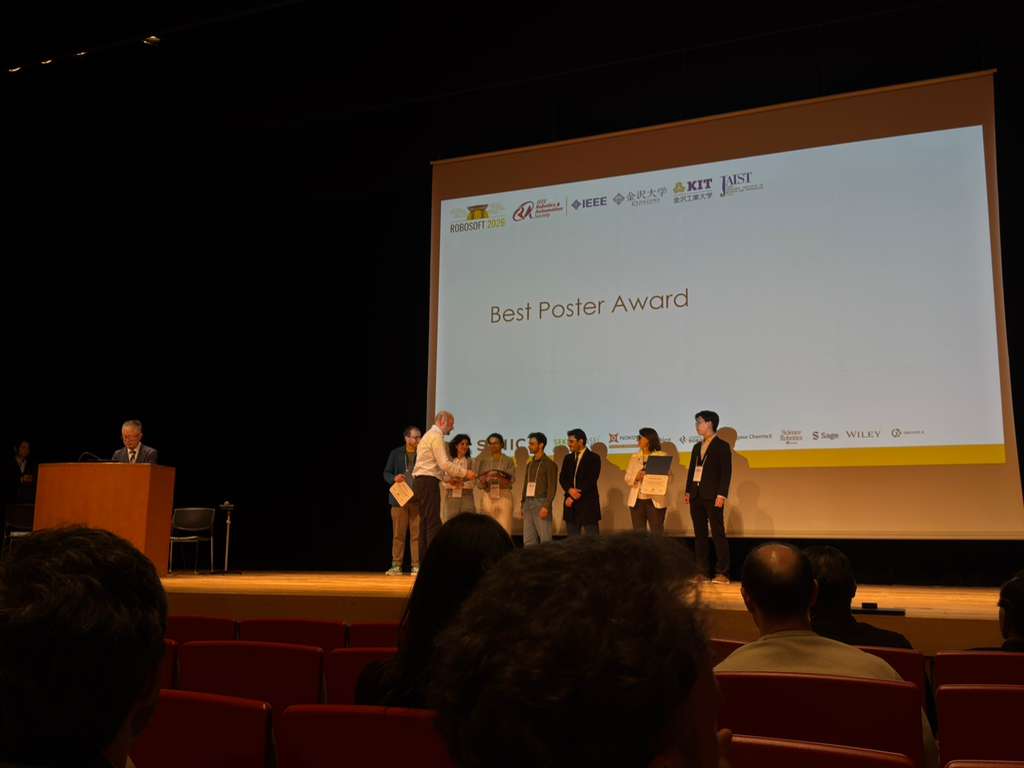
Best posters award ceremony, with IIT on stage.
At its core, the work addresses a fundamental challenge for MOZART: making a robot’s manipulator surface intelligent enough to adapt to different objects and tasks. IIT’s team developed a programmable sensing layer made from 3D-printed lattice structures – imagine a “smart skin” that simultaneously detects object weight and force while actively guiding objects’ movement by varying stiffness across different regions, like an adaptive conveyor belt.
What makes this approach truly innovative is that the same physical structure provides both sensing capability and mechanical guidance. By adjusting lattice parameters like cell size and density, the system can be tailored to specific applications: delicate assembly tasks might require high sensitivity, while heavy industrial pick-and-place operations would demand a larger operational force range.
Early results show that objects roll at different speeds depending on surface stiffness, and that the sensing response is robust – it works reliably regardless of whether an object is rigid or soft, smooth or irregular. The implications extend beyond the immediate technology. By programming stiffness gradients across a surface, researchers can guide object trajectories without active control, using only geometry and physics.
This opens pathways for designing manipulation systems that are both responsive (they know what they are touching) and adaptive (they adjust behaviour based on what they sense) – core objectives for MOZART’s vision of robots performing complex, real-world tasks with varying object types and shapes.
The research drew further attention on April 11, when the same team presented at the workshop “Frontiers of Physically Intelligent Robots with Architected Soft Materials”. Muhammad Awais, Gayatri Indukumar, and Diana Cafiso presented “3D-Printed Lattices as a Modulating Layer for Soft Inductive Tactile Sensors“, exploring how lattice design can simultaneously optimise mechanical and sensing properties. This dual recognition underscores the significance of IIT’s contribution to the soft robotics and intelligent manipulation landscape.
Images courtesy of IIT