

Streamlining Poultry Processing: The Role of Automation and Human Skill
To remain competitive, and simultaneously ensure the highest degree of animal welfare, sustainability, and food quality & safety, the poultry industry will need the support of the latest developments in technology and scientific research.
Introduction
In the most recent estimates, poultry meat consumption in the European Union is projected to increase by 0.5% per year between the 2022-2024 average and 2035, resulting in an annual per capita consumption rise from 24.2 kg to 25.8 kg (EU Commission, 2025). Globally, poultry meat is estimated to represent a total of 43% of all the protein from meat sources by 2033, driven by affordability, nutritional benefits, and environmental considerations (OCSE-FAO, 2024).
The European poultry sector will have to face an internal increase in demand while competing with the projected increase in production internationally. To face these challenges, remain competitive, and simultaneously ensure the highest degree of animal welfare, sustainability, and food quality & safety, the poultry industry will need the support of the latest developments in technology and scientific research.
In this context, this article aims to describe and explain the current state of the art in the last stages of poultry production: slaughter and processing, to then pinpoint which of the different steps could be improved and benefit from the MOZART technology.

Poultry meat processing plant.
Poultry processing in the EU
The European poultry slaughterhouses operate by combining advanced automation with skilled labour to maximize efficiency, food safety, and product quality. With cutting-edge technologies and stringent regulatory standards, these facilities process chicken carcasses accurately and efficiently. While automation handles much of the work, skilled workers ensure precision in tasks that require manual intervention, and ongoing technological advancements continue to offer opportunities for further optimization.
The slaughter and meat processing stages of poultry production entail every single step taken from the moment the broilers (broilers are any chicken that is bred and raised specifically for the purpose of producing meat) arrive at the slaughterhouse, until the meat, whether in the form of whole birds, cuts, or further processed meats, is packaged and transported to retailers.
1- Live animal handling
The live animal handling phase involves transporting broiler chickens from farms to slaughterhouses. Upon arrival, the birds are unloaded from trucks and placed in a “lairage” area, a designated space where they are kept for a resting period to recover from transport stress before proceeding to slaughter. The next steps are largely automated, with forklifts used for unloading, loading, and moving containers. Specialized equipment then transfers the birds from their crates to the stunning machine, all under the supervision of trained operators.
2- Stunning and slaughter
The next steps, stunning and slaughter, are crucial for ensuring proper handling and efficient processing. Stunning, which renders birds unconscious and insensible to pain, can be achieved through electrical stunning – either by water bath or head-only methods – or controlled atmosphere stunning (CAS), which uses gas or low atmospheric pressure. Once stunned, the birds undergo bleeding, where both carotid arteries are severed to induce death. This process is usually automated, and trained workers ensure birds are fully unconscious before bleeding and confirmed dead before further processing (feather removal, evisceration and cleaning) (EFSA, 2019)
3- Cleaning, feather removal and evisceration
After confirming the broiler’s death, the carcass undergoes several steps to harvest the meat. First, the carcass is immersed in scalding water to clean and prepare it for processing. Next, de-feathering removes all feathers, followed by evisceration to hygienically dispose of the internal organs and viscera. Each bird undergoes post-mortem inspection by veterinarians and plant operators, who check for any food safety or quality issues. The carcass is then chilled to ensure optimal shelf life, presentation, meat structure, and the final yield of poultry products. Finally, the carcass is weighed, graded, and distributed, especially if whole birds are the product being produced. This part of the processing line is highly automated, with machines handling most of the tasks. However, throughout this process, humans play a crucial role in overseeing the process and monitoring the machines, performing quality checks, and ensuring adherence to food safety standards.
4- Processing, cutting, and meat preparation
Following the slaughter and chilling of the chickens, the next phase involves cutting and deboning the carcasses to produce various poultry products, including chicken wings, drumsticks, and breasts. Over the years, this phase has become highly automated, with machines taking on the bulk of the cutting, portioning, and deboning tasks. Advanced machinery streamlines the process, allowing for consistent cuts and optimal yields, improving both the quality and the speed of production. However, despite the advanced technology, some cuts are still done manually by skilled operators. This ensures that the quality of each piece meets the desired specifications, particularly for cuts that require a higher level of precision.
In addition to whole cuts, some chicken may be cooked directly in the plant or sent to specialized facilities where it is further processed into value-added products like chicken nuggets, burgers, or frozen meals. This allows the poultry industry to cater to a wide range of consumer preferences while maintaining high standards of food safety.
5- Packaging and end-of-line
Once poultry has been processed, the packaging phase involves portioning, sealing, labelling, and sometimes even vacuum or modified atmosphere packaging (MAP) to extend shelf life. This stage must be swift and precise to prevent contamination and product loss. Traditionally, packaging relied heavily on manual labour, but the landscape is changing with the introduction of automation, AI, and robotics.
The last part of poultry processing is the packaging and loading of the product into the trucks to prepare them for sale to retailers, restauration, caterers, etc. The end-of-line phase also entails cooling and freezing of the chicken meat and the rendering and processing of waste derived from the production process. In this phase automation systems are also critical to ensure the safe handling of the meats, as well as to guarantee the efficient functioning of the plant and a steady output of products.
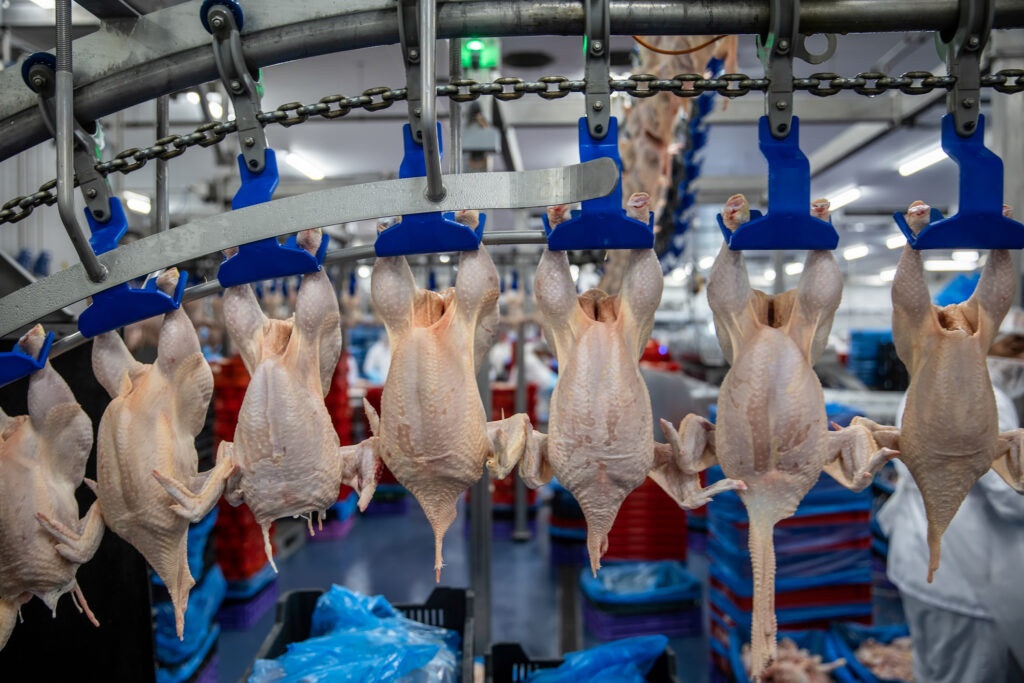
Chickens in slaughterhouse
The Mozart project: A game-changer for food processing
One of the most promising initiatives in this technological evolution is the Mozart project, which is developing collaborative robotics and AI-driven solutions to optimize food processing lines. This EU-funded initiative focuses on flexible, intelligent robotics that can adapt to different food processing tasks – including those in poultry plants.
For slaughterhouses, the Mozart Project could mean:
- Smarter automation: AI-driven robotic systems that can adapt to irregular shapes of poultry parts and perform delicate tasks with precision.
- Collaborative robots: Machines that work alongside human workers, reducing the risk of injury while increasing efficiency.
- Support the green transition of the food processing industry through the development of soft tactile robotics to manipulate fresh, fragile food products.
But the impact goes beyond poultry. The same robotic solutions can be applied to other food supply chains, including seafood, dairy, and fresh produce. By integrating intelligent automation, food processors across industries can reduce waste, increase efficiency, and ensure product consistency – plus support workers in physically demanding roles – all while maintaining the highest food safety standards.
Conclusions
In conclusion, slaughter and processing are critical phases in poultry meat production, heavily reliant on mechanical tools and automated systems. While these technologies have significantly improved efficiency and safety, there remains ample opportunity for further enhancement through research and development initiatives, such as the MOZART project. The collaboration between automation and skilled human workers ensures that the poultry industry can meet evolving market demands while maintaining high standards of quality. As technology continues to progress, human expertise will remain essential in overseeing and optimizing the production of top-quality poultry products.
Authors: AVEC – Association of Poultry Processors and Poultry Trade in the EU countries