

Do (not) fear the dancing automaton! Automation anxieties in ballet
Through choreographed movement, robot-like dancers explore emotion, embodiment, and the changing meaning of human life in an age shaped by machines and mechanical reproduction.
In this blog series, on “HRI, automation, and emotions: Do (not) fear the robots!,” we discuss cultural narratives around automation to explore different articulations of “robotics fear”—societal concerns and anxieties about robots.
Long before the advent of modern robotics, moving mechanical figures fascinated audiences in royal courts, private salons, and eventually public exhibitions. Among the most celebrated of these were dancing automata, elegantly crafted machines that twirled, bowed, and moved their limbs in time with music. From delicate ballerinas pirouetting on musical boxes to lifelike figures that mimicked human gestures, these automata were admired as both technological marvels and objects of art, laying the groundwork for how later art forms would come to imagine the mechanical body. This fascination eventually found its way onto the ballet stage. From the late 19th century, human dancers began performing as automata and marionettes. Viewing robots through the lens of dance invites us to consider how movement alone can suggest emotion. Even in the absence of expression or voice, gesture can powerfully evoke fear, wonder, empathy, or hope. In doing so, it reflects our shifting, often ambivalent relationship with artificial figures that imitate life. Indeed, Austin (2016) argues that automatons in ballet are more than theatrical gimmicks: they express deeper anxieties about what movement means, what life means, what the human body is in an age of machines and mechanical reproduction.
A pioneering dance-based exploration of the emotional confusion and fascination surrounding automata is Coppélia, a comic ballet first performed in 1870, with music by Léo Delibes and choreography by Arthur Saint-Léon. Loosely based on E.T.A. Hoffmann’s short story “The Sandman,” the ballet tells the story of Dr. Coppélius, an eccentric inventor who creates a life-sized mechanical doll, named Coppélia (Olympia in Hoffman’s story). The automaton captures the romantic attention of young villager Franz, much to the dismay of his fiancée, Swanilda. When Swanilda discovers that Coppélia is not real, and that Dr. Coppélius is planning to give her life by sacrificing Franz’ soul, she disguises herself as the doll to halt the plan and take back Franz’ attentions. While lighter in tone than Hoffmann’s original tale, Coppélia reflects underlying anxieties about humans being replaced by efficient, obedient machines. Yet the choreography alleviates the fear of human obsolescence, as Reilly observes: “the beauty of the human movement surpasses the rigid formal movement of the machine, thus momentarily relieving any fear of humans being upstaged by more perfect machines” (2011: 138). Coppélia thus stages the uncanny fascination of artificial perfection, but ultimately reaffirms the superior vitality of the human through dance.
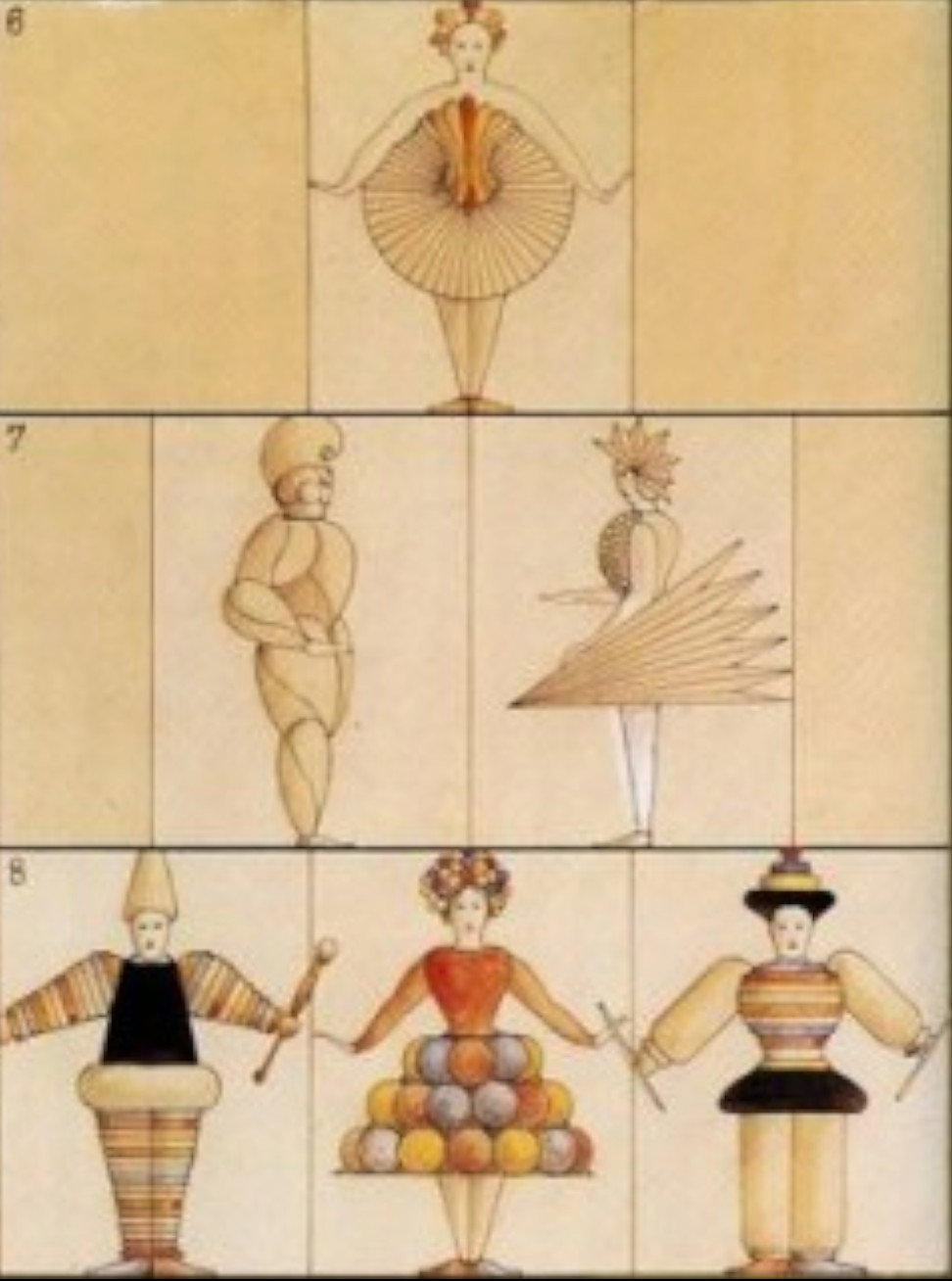
Mechanical movements are absolute protagonists of another choreography, the Triadic Ballet by Oskar Schlemmer. In this avant-garde performance, first presented in 1922, human figures are transformed into geometric forms, moving in calculated, puppet-like motions that blur the boundary between man and machine. As a leading figure in the Bauhaus movement, Schlemmer envisioned the ballet as a “total work of art” (Gesamtkunstwerk), integrating visual art, dance, theatre, and design. He encouraged his students to imitate puppet-like gestures as a way to break free from conventional dance vocabularies and explore new, abstract expressions of the body. Schlemmer’s costume designs, made from rigid materials such as metal and papier-mâché, intentionally limited the dancers’ mobility, encouraging their mechanical movements. Yet, his goal was never to reduce the dancer to a machine, but rather to explore mechanisation as a way (among others) to represent the human experience. To him mechanisation was “the inexorable process which now lays claim to every sphere of life and art. Everything which can be mechanised is mechanised. The result: our recognition of that which cannot be mechanised” (in Lauhsen 1986:70). As Coppélia, the Triadic Ballet uses mechanical movements not to evoke fears of human obsolescence, but to counter them. Schlemmer reimagines the human body as a symbol of modernity, both shaped by and resisting the mechanised world it inhabits.
A darker set of feelings is elicited by another performance, not an entire ballet but a dance—that of Maria in the iconic Fritz Lang’s movie Metropolis (1927). The film portrays a dystopian, technologically advanced society divided between a wealthy elite and oppressed workers. Maria, a moral leader among the workers, becomes a threat to the ruling class, who fear an uprising. To destroy her credibility and influence, they create a robotic double to impersonate her and incite chaos among the workforce. In the famous dance scene, robot-Maria is initially presented as an antique mechanical doll, slowly rotating on herself after emerging from a pedestal that resembles a musical box. But unlike the delicate, virginal figure of classical ballerinas, she wears a highly revealing, provocative outfit which barely covers her body. Her movements quickly become overtly sexual, as also testified by the mesmerised gaze of the male spectators and by Biblical references to the Whore of Babylon. Robot-Maria’s dance operates on multiple symbolic levels. It turns the female body into a tool of seduction and control, transforming dance from a form of art into one of manipulation. She embodies contemporary anxieties about female sexuality as a disruptive, uncontrollable force, while also reflecting deeper fears surrounding technology as a driver of social inequality, and the breakdown of traditional gender roles in a rapidly modernising world.
The dances in Coppélia, The Triadic Ballet, and Metropolis each convey distinct emotional registers, yet all are shaped by a tension between the mechanical and the human. Taken together, these works reveal how mechanical beings can be playful, provocative, or deeply unsettling, mirroring changing emotions around humans’ place in a mechanised world.
Bibliography
Austin, L. M. (2016). Elaborations of the Machine: The Automata Ballets. Modernism/modernity, 23(1), 65-87.
Lahusen, S. (1986). Oskar Schlemmer: mechanical ballets?. Dance Research, 4(2), 65-77.
Reilly, K. (2011). Automata and mimesis on the stage of theatre history. Springer.
Wosk, J. (2019). My fair ladies: Female robots, androids, and other artificial eves. Rutgers University Press.