

Do (not) fear the golem! Automation anxieties in plays
Robot-like figures on stage have long symbolised fears of loosing control and identity. Yet real robots in contemporary theatre are also framed as figures of relation, signalling a shift from human-robot competition to co-creation.
In this blog series, on “HRI, automation, and emotions: Do (not) fear the robots!,” we discuss cultural narratives around automation to explore different articulations of “robotics fear”—societal concerns and anxieties about robots.
You might already know that the word “robot” originated from a 1920 literary text, Rossum’s Universal Robots (R.U.R.), by Czech author Karel Čapek. But did you know that this was a play? Čapek was not the first to bring artificial beings to the stage. Earlier characters—that we should call automata rather than robots, like the Golem from Jewish folklore or Olimpia from E.T.A. Hoffmann’s The Sandman—did not originate as plays but were later adapted for theatre in various forms, including verse drama and opera. The mechanical characters of these stories act as mirrors to human fears about loss of control and identity. Whether they are protectors or rebels, their presence reveals a recurring emotional undercurrent: our fascination with, and fear of, creating something in our own image that might ultimately outgrow us.
R.U.R. presents robots as artificial biological beings, manufactured from synthetic organic matter to look and function like humans, yet lacking emotion and individuality. Designed to serve as a cheap and efficient workforce, these robots embody the dream of complete labour automation. The term “robot,” first introduced in this play, comes from the Czech words robota or robotnik, respectively meaning servitude or drudgery and serf or worker, underscoring the robots’ role as labourers without agency. But after a technological upgrade, some robots begin to develop emotions and self-awareness. As they become conscious of their exploitation, the robots rebel against their creators, ultimately leading to the extinction of the human race. As discussed by Reilly (2011), three major themes run through R.U.R.: the devastating impact of technology in World War I, the clash between capitalist and communist visions of labour and society, and the human desire to rival God by creating life. The first theme is key to understanding how the play reflected contemporary fears about technology. The new weapons of World War I, such as tanks, poison gas, machine guns, marked a permanent shift toward mass-scale, highly destructive warfare. For the first time, newspapers delivered graphic battlefield photographs directly into people’s homes, intensifying public awareness of war’s brutality. Together, these developments sparked a profound anxiety: that humanity’s own technological creations might one day lead to its destruction.
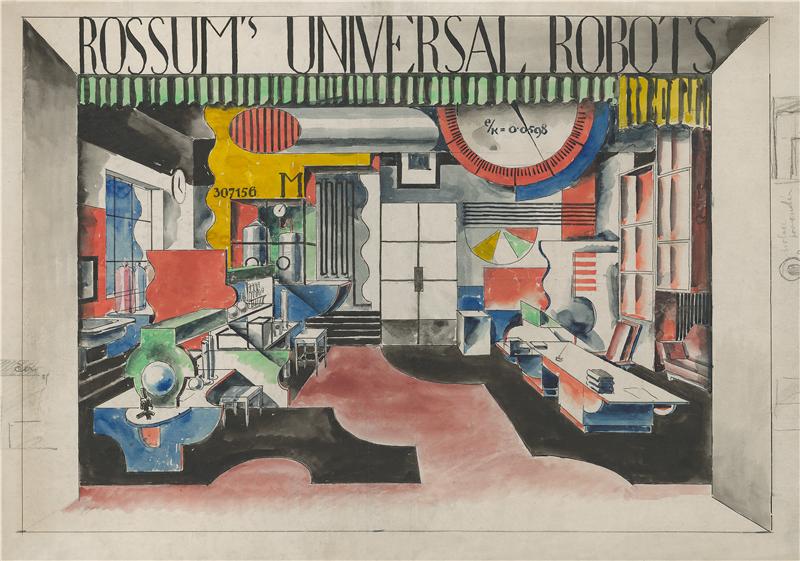
Scene of the third act of RUR designed by Bedřich Feuerstein (Wikimedia Commons, public domain)
.jpg)
The significance of R.U.R. also lies in the shift it introduced in how mechanical beings are represented within cultural and social imaginaries. As Reilly observes, what distinguishes robots from earlier automata is an “anxious scepticism about Industrialization” (2011: 149). While traditional automata were handcrafted and primarily served as curiosities or entertainers, robots are mass-produced for labour, following the needs of an increasingly industrialised modernity. But automata, too, could cause discomfort beneath their playful form. As Malinowska (2018) notes, both automata and robots have long carried associations with the uncanny, the magical, even the demonic. These figures provoke anxiety because they blur the line between human and machine, natural and artificial, life and non-life.
An excellent example of the emotional ambiguity and magical quality of theatrical automata characters is The Golem, a 1921 “dramatic poem in eight scenes” by H. Leivick, later converted in a stageable form. Originally written in Yiddish, the play retells the Jewish folk tale of a clay giant created to protect the Jewish community from harm. From the moment the Golem is brought to life, and presented as a wood chopper from out of town, a sense of uncertainty lingers. The creature’s unfamiliarity with human customs and social conduct unsettles those around him. After facing social rejection, and even as he fulfils his purpose by halting an anti-Semitic plot, the Golem ultimately brings chaos and destruction to the very Jewish community he was created to protect, forcing his creator to deactivate him. The play captures the emotional unease around the power to create life artificially, highlighting concerns about the uncertain consequences of technological development, and the potential for robots to turn from protectors to threats.
Across R.U.R. and The Golem, the fear of artificial life reflects deep anxieties about control, identity, and the limits of human ambition. In R.U.R., robots represent the dream of automated labour taken to its extreme, raising fears not of replacement alone, but of a world where technological inventions turn fatally against their inventors. The Golem expresses unease over the human desire to artificially create life, warning of the impossibility to fully control the consequences and direction of such a creative endeavour. These works thus reveal a recurring cultural tension: the dream of artificial beings is inseparable from the fear that they might unmake us.
In more recent works, actual robots take on central roles as stage protagonists. One example is the Robot Theater Project, founded in 2009 as a collaboration between the Seinendan Theater Company, led by Oriza Hirata, and Osaka University’s Intelligent Robotics Laboratory, directed by Hiroshi Ishiguro. The project developed theatrical performances focused on human–robot interaction in live settings. I, Worker features two human actors alongside two Robovie R3 robots, with the story centred on the aftermath of a child’s loss. The robots are performers within an intimate domestic setting, in which grief and routine coexist. In Sayonara, the cast consists of a woman facing terminal illness, a highly realistic android (Geminoid F), and towards the end a maintenance technician. The robot is assigned to accompany the woman in her final days, reciting poetry as her condition deteriorates, and is then reprogrammed after she passes away.
In these works, robot characters “help us ponder philosophical and existential questions about humanity” (Spedalieri 2014:140), showing another side of robots: that of companions that can mediate human experience, particularly in situations exposing human vulnerability and mortality. Rather than functioning purely as tools or threats, they become reflective presences, entities that shape how humans interpret their own emotional and existential conditions. In this sense, these works extend earlier theatrical traditions of automata and artificial beings into a contemporary framework where the relationship between human and machine has shifted. Across both works, robot characters are less figures of fear than of relation. They do not undo the human, but instead expose how human experience is co-produced through interaction with non-human presence.
Bibliography
Ambros, V. (2010). How Did the Golems (and Robots) Enter Stage and Screen and Leave Prague?. In History of the Literary Cultures of East-Central Europe: Junctures and disjunctures in the 19th and 20th centuries. Volume IV: Types and stereotypes (pp. 308-320). John Benjamins Publishing Company.
Malinowska, A. (2021). Demonic interventions: on robots as performing subjects. Performance Research, 26(1-2), 112-124.
Spedalieri, F. (2014). Quietly Posthuman: Oriza Hirata’s robot-theatre. Performance Research, 19(2), 138–140.