

Animals of soft robotics. Journey through MOZART’s robotics labs, pt 4
In which we learn how the biological world inspires soft robotics innovation
MOZART’s social sciences and humanities team embarked on a journey across our partnering robotics labs to find out all about soft robotics. We learned that soft robotics is not only based on innovative engineering solutions, but also establishes new relationships between humans and machines, and between nature and technology. During our visit to MOZART’s robotics labs, we organised an interdisciplinary workshop to creatively explore different ways to define and describe soft robotics. The workshops were conducted by Ginevra Sanvitale. In this new series of posts, we present the results.
To conclude this blog series, I will focus on a final aspect of soft robotics development that particularly captured my attention during the MOZART lab visits and workshops: the role of animals and plants in inspiring new designs and applications. Animals have long played a role in robotics imaginaries. Think of the many robot dogs populating the history of technology: during the 1940 New York World’s Fair, for example, the Westinghouse Electric Corporation presented Sparko, a robotic dog able to sit, beg, and bark, companion to the humanoid robot Elektro. These were one-of-a-kind prototypes, used for promotional activities. But, from the 2000s, several robot-dogs have been released to the consumer market, such as the pioneer Sony’s AIBO, and Tekno the Robot Puppy, which was also featured in a Time’s magazine cover.
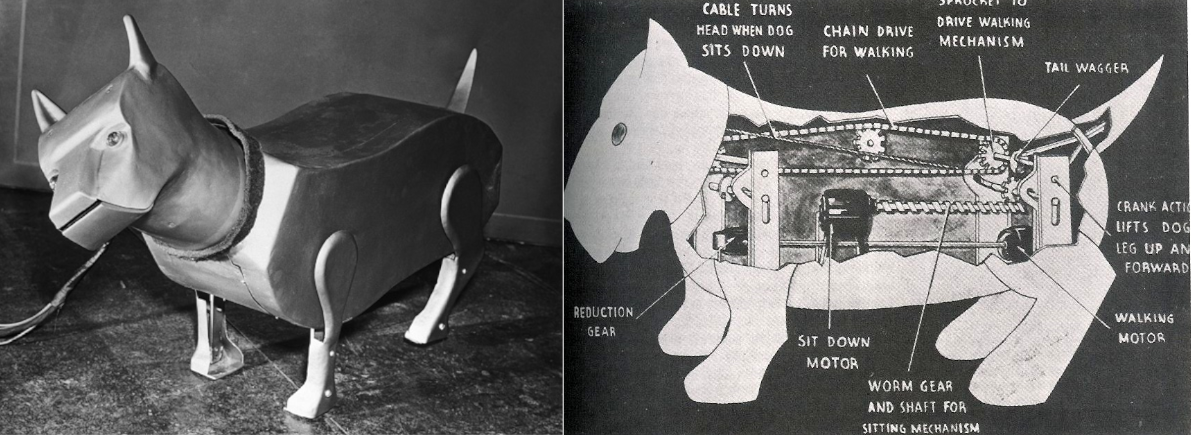
The outside and inside of Sparko, one of the first robot dogs (1940)
But the bio-inspired prototypes developed in soft robotics are more complex and fascinating. From a new feminist materialist perspective, these robots don’t just function differently: they represent a different philosophy of design and relation, where life, matter, and machines are deeply entangled. Bio-inspired soft robotics challenges traditional, human-centered approaches to technology by drawing directly from the intelligence of the animal world. They do not seek to mimic exact animal shapes, but to replicate their biological principles and functions. Rather than treating animals as mere metaphors or models, this design philosophy positions nonhuman life as an active partner in innovation. By embracing the forms, behaviors, and adaptive capacities of living organisms, these robots decentralise the human and invite us to rethink intelligence and agency as distributed across species and materials. This shift not only advances robotics but opens up more ethical and ecologically attuned ways of designing for the complex world we inhabit.
Animals offer valuable models for designing robots that can move through challenging environments, manipulate delicate objects, and safely interact with humans. One of the most popular animals in soft robotics is the octopus, due to its soft body, remarkable dexterity, and flexible limbs. Several pioneering octopus-inspired soft robotics projects have emerged over the past two decades, such as the OctArm, developed since 2005 at the University of Pennsylvania, or Harvard’s Octobot, which also offers an example of a chemical-powered soft robot. Another highly appreciated animal in the field is the elephant, particularly for its trunk. MOZART partners at the Italian Institute of Technology (IIT), for example, have been working to reproduce the anatomical and morphological properties of the elephant trunk in the project Proboscis.
Invertebrates are especially relevant for bio-inspired robots. Creatures like snails, worms, or squids, can squeeze, stretch, bend, and twist in ways that are very difficult for vertebrates due to their joints and bones. Soft robots inspired by invertebrates can navigate tight spaces, conform to irregular shapes, and survive impacts. Similar functions are very valuable in fields like surgery, exploration, or disaster recovery. Butterflies and other insects offer inspiration through their light, flexible wings and agile flight mechanics. These features are especially useful in the development of small aerial robots and soft-wing drones.
Beyond soft robotics, insects are also a popular source of inspiration in the field of swarm robotics, together with fishes, birds, and other animals moving in large groups. Swarm robots work together to collectively accomplish tasks that would be difficult or impossible for a single robot to achieve. The field of soft swarm robotics is also emerging, exploring what happens when the individual robotics units are soft-bodied, flexible, and capable of deforming. For example, jellyfish-like robots that swim together are being developed for marine exploration.

Jellyfish is a promising source of inspiration for soft swarm robotics (picture by Matteo De Felice, License CC-BY-NC-SA 2.0)
Not only animals, but also plants can provide inspiration for new soft robotics developments and applications. Researchers are increasingly looking at plant movements, growth, and adaptability as models for novel, energy-efficient robotic systems. Robotics researchers investigate the properties and functioning of roots and vines, to create robots that can grow, move, or anchor themselves by extending their body like a plant. As in the case of animals, soft robots inspired by plants challenge traditional ideas of what a robot looks and moves like, offering a new paradigm for creating machines that blend more seamlessly with natural environments.
Bio-inspired soft robots thus represent a significant advancement in robotics, combining principles from biology and materials science to create systems that are capable of complex interactions with their environments and show great adaptability to a variety of tasks and contexts. By emulating the form and function of living organisms, these robots offer promising solutions for applications in healthcare, environmental monitoring, and search and rescue, where traditional rigid systems often fall short. Furthermore, their reliance on low-energy, material-efficient designs inspired by nature contributes to the development of more sustainable and environmentally conscious robotic technologies.
Ginevra Sanvitale
Bibliography
Barad, Karen. (2007). Meeting the universe halfway: Quantum physics and the entanglement of matter and meaning. Duke University Press.
Gemeinboeck, Petra and Rob Saunders. (2023). Dancing with the nonhuman: A feminist, embodied, material inquiry into the making of human-robot relationships. In Companion of the 2023 ACM/IEEE international conference on human-robot interaction (pp. 51-59).
Haraway, Donna. (1988). Situated Knowledges: The Science Question in Feminism and the Privilege of Partial Perspective. Feminist Studies, 14(3), 575–599.
Suchman, Lucy A. (2007). Human-machine reconfigurations: Plans and situated actions. Cambridge University Press.