

Do (not) fear the mechanical cow! Automation anxieties in cartoons
Three animated shorts from the 1920s and 1930s reveal the ambivalent attitudes surrounding automation in a world where the boundaries between nature and machine were becoming increasingly blurred.
In this blog series, on “HRI, automation, and emotions: Do (not) fear the robots!,” we discuss cultural narratives around automation to explore different articulations of “robotics fear”—societal concerns and anxieties about robots.
Since antiquity, robots and automata have captured the human imagination, appearing in myths and literature. This fascination carried into modern cultural products, including early 20th-century animated cartoons, where robots became frequent characters to satirise technocracy, the idea of governance by technical experts. As Telotte notes, “these cartoons were simply working out our relationship to the world of science and technology, allowing us to laugh at—and with—this modernist vision in both its troubling and its hopeful forms” (2021:13). Extending Telotte’s point, we can see these cartoons not just as critiques of technocratic ideals, but as broader reflections on society’s ambivalence toward emerging technologies, underscoring both its fascination with progress and its anxiety over its unpredictable consequences.
In these early animated cartoons, mechanical cows were symbols of the contemporary hopes and fears surrounding automation and modernity. Indeed, before the rise of robotics and industrial automation, animals were humanity’s primary partners in labour and everyday tasks. As argued by Darling, “Using animals to think about robots acknowledges our inherent tendency to project life onto this technology” (2021:xv). Through the hybridisation of animal and machine forms, 1920s-1930s cartoons visualised a world in transition where the boundaries between nature and machine were increasingly blurred, reflecting a historical shift from biological to mechanical sources of labour.
The Mechanical Cow (1927), made by Walt Disney for Winkler Production within the series “Oswald the Lucky Rabbit,” is one of the earliest examples of automated animals in cartoons. Oswald runs a milk delivery service with the help of his mechanical cow, that despite its artificial nature behaves similarly to a living being—laziness included. The cartoon starts with Oswald trying to get the reluctant cow out of bed, and out to work. While on their daily milk delivery route, two crooks in a car kidnap Oswald’s girlfriend, Fanny. Oswald jumps onto the mechanical cow and gives chase. In a wild turn, all of them go over a cliff, but Oswald and Fanny survive the fall, and ride off safely on the cow.
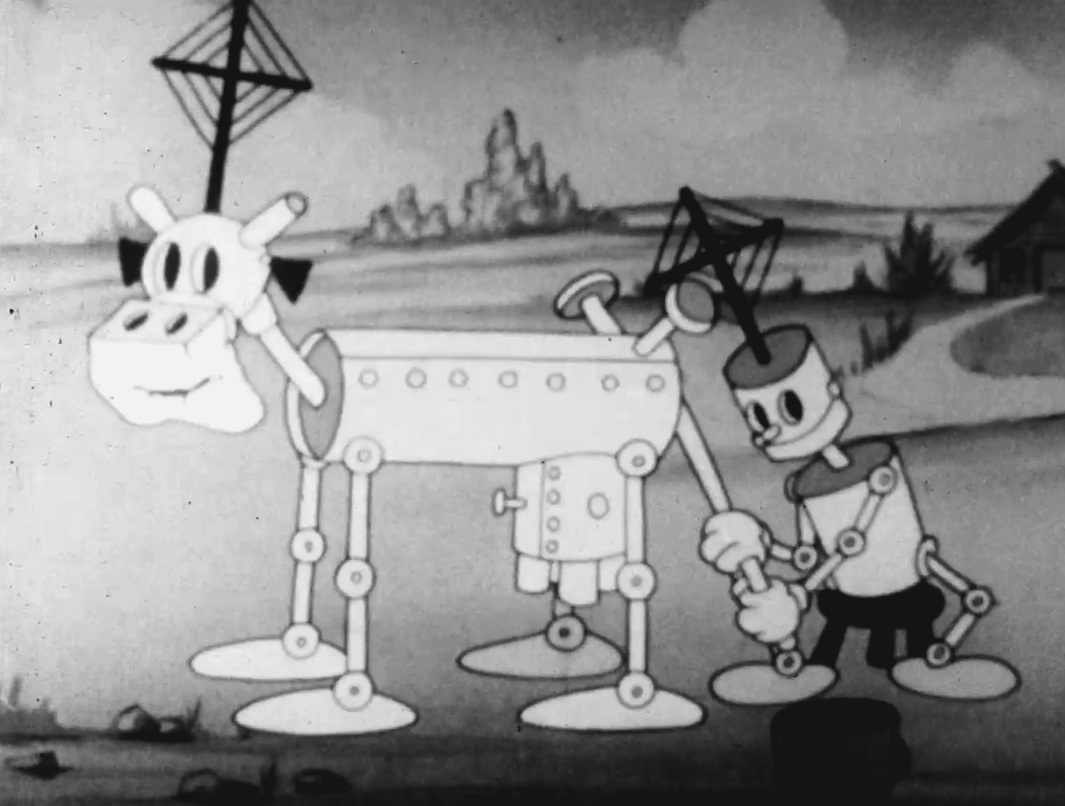
A mechanical cow is also featured, alongside other robotic livestock, in Columbia’s Technoracket (1933). Scrappy runs a farm with the help of his farmhand, Oopie. One day, after reading a newspaper article about technocracy, Scrappy decides to modernise his business. He lays off his animal and human workers, replacing them with an army of robotic livestock that perform absurdly efficient tasks. But the technological utopia quickly ends, as Oopie and the animals sabotage the system and the robots spiral out of control. Chaos erupts, and Scrappy is forced to destroy the machines and return to living labour.
Another cartoon titled The mechanical cow was produced by Terrytoons in 1937. Farmer Al Falfa’s cow has gone on strike. It wears a protest sign as a saddle, and refuses to be milked. Al thus decides to build a mechanical cow out of old junk he finds around the farm. At first, it seems to work fine. But the real cow gets curious and walks over to check the robot out. The mechanical cow ends up eating the protest sign, and goes on strike too. An angered Al kicks the machine, starting a comical sequence which leads to the mechanical cow escaping his control. The robot starts creating chaos on the farm, and its wild run is only stopped by the arrival of a train. Al and his living cow joyfully reconcile, but they are soon interrupted by the train chasing them.
All three animated movies share an underlining fascination with the possibilities offered by technological development, embodied by their prodigious robotic animals. Oswald’s mechanical cow is part animal, part vehicle; it gets milked by using the tail as a lever, and its udders extend into feeding tubes, while its neck can turn into a ladder. Equally mesmerising, Scrappy’s mechanical cow is activated via wireless technology, and produces milk bottles from its udders, also in this case thanks to a tail-lever. Al Falfa’s self-built mechanical cow is activated through a small lever on its neck. It has no udders, and ejects milk bottles directly from its body as soon as it gets fed with hay. Despite their occasional antics and malfunctioning, these mechanical cows are highly advanced technological innovations.
But their role in the story is not always a positive one. Oswald’s mechanical cow is quite different from the other two, as it reflects a hopeful vision of technological progress in which robotics and automation serve as helpful companions to humans. Its characterisation is undoubtedly favourable, and the cow is something more than a robot, realising the connection between the artificial and natural world. Its behaviour resembles that of an actual animal, with a cranky morning start, and its features are not entirely mechanical—its face being that of a living cow. By contrast, Scrappy and Al Falfa’s stories reveal more conflicted automation imaginaries. In both cases, the mechanical cows are brought to the farm to replace human and animal workers, with the storyline being sympathetic towards the latter. Scrappy is the most negative character in all these short movies, reflecting the authors’ intent to satirise the technocracy movement. Whereas Al Falfa builds a mechanical cow because the living one is on strike, Scrappy’s employees are regularly performing their duties when he decides to mechanise the farm—and not to aid the workers, but to substitute them. This scenario evokes a classic robotics fear: that of workers being replaced by automation. But the cartoon also points at the complementary concern of machines being destroyed by workers, as Scrappy’s automated farm ultimately goes into chaos due to sabotage by his former employees. Al Falfa’s cartoon further explore the theme of workers’ unrest, pointing to fears of automation being used as an anti-strike tool. And here the mechanical cow’s malfunction is unintentional, revealing another typical robotics fear: that of machines escaping human control.
The shifting attitude to automation in these cartoons mirrors wider socio-political transformations of the period. Especially in the US, the “roaring twenties” where characterised by a booming economy and increased societal well-being. Technology was largely seen as a force for growth, freedom and modernity, as exemplified by Oswald’s mechanical cow. This changed after the 1929 economic crisis and ensuing Great Depression. Amidst mass unemployment and rapidly decreasing living standards, workers often envisioned automation as a job killer and a tool for employers to maintain strict control over the workforce. From the mid-1930s, US labour unions significantly increased their numbers and influence. While automation remained a concern for job security, it was seen as less threatening in the context of growing workers’ bargaining power and improving living conditions. In short, whether automation was a miracle or a menace often depended on who it seemed to serve—and on how full your pantry was.
Bibliography
Darling, K. (2021). The new breed: what our history with animals reveals about our future with robots. Henry Holt and Company.
Telotte, J. P. (2021). Animating the Technocratic Utopia. Film & History: An Interdisciplinary Journal, 51(1), 4-14.