

Fox in the Henhouse: Hunting for Insights at IPPE
A blogpost in which we follow the polished machinery and conversations at IPPE in search of what makes automation work in practice.
The hall in front of me seems huge. Booth after booth stretches into the distance. I can see endless rows of machinery of all sorts, polished to perfection. Stainless steel lines, conveyor belts, robotic arms, dashboards flashing numbers and signals in bright, confident colors.
Outside, the snowstorm that threatened to disrupt the event has cleared. The Georgia sun hits the glass façade of the World Congress Center, and inside, crowds of professionals are talking poultry.
Badges swing from suits. Polished shoes hit the acres of carpets, firm handshakes, and professional wide smiles welcome the business partners. Most attendees look like they know why they arrived today – to see what’s new, what’s faster, what might give them an edge, or how to rekindle their business connections.
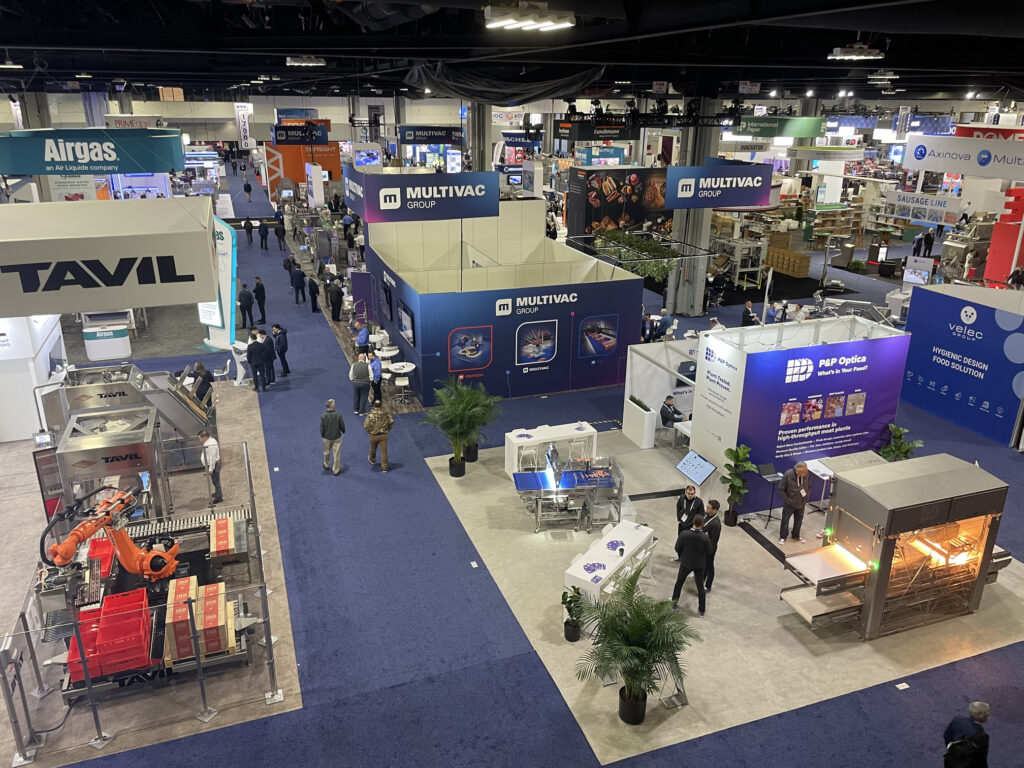
IPPE exhibition floor: a landscape of automation, processing lines, and industry conversations
We are at IPPE, the International Production & Processing Expo. And it feels like everyone who means something in the poultry industry is here today. Including me, representing the SSH team from the MOZART project.
On the screen in front of me, a 3D model of a chicken rotates slowly as a lidar scanner maps its exact dimensions. A few meters away, a line stretching maybe 15 meters (or say 50 feet in the local measures) disassembles a whole bird into precise cuts in seconds. Further down the aisle, suction cups lift and place dozens of eggs in cartons with mechanical certainty. Everything looks precise. Everything is optimized. Everything promises efficiency.
A sharp smell and a speaker system announce that a hot wings-eating competition is underway. In another corner, a machine forms burgers as the magnetic conveyor belt is organizing slices of bacon. Everything in here seems to orbit the same question: how do you reduce waste, increase yield, and keep things moving out of the door of the production line in the most efficient way?
And yet, in between the polished machines, there are open people who came here to talk. Eye contact or a quick nod is enough to start a conversation. “Do you have any questions about our product? And what do you do? Oh, university, doing research.” For some, this information is enough to politely end the conversation (they are here for business, after all). Others are still willing to talk, discuss the industry’s future, or give us feedback on MOZART.
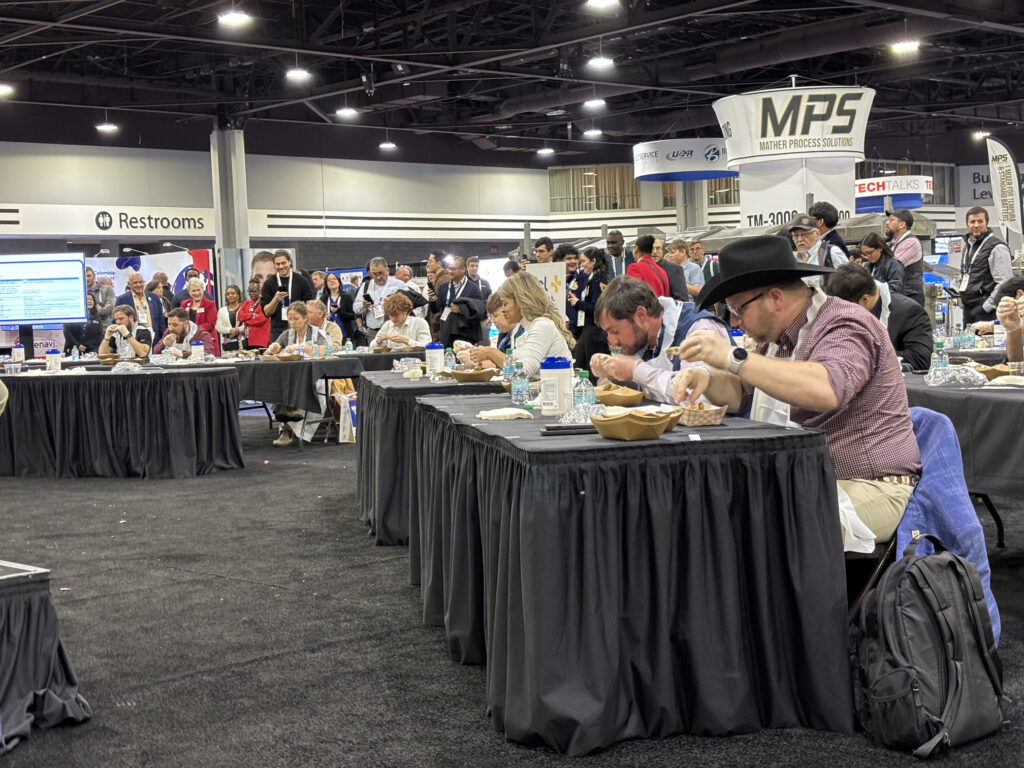
Wing eating competition.
The Hunt
And that is why I am here. Not to buy equipment. Not to negotiate contracts or calculate yield per minute. I am walking the aisles, mapping the landscape, and trying to understand what the industry sees as the next step, what it would take for new systems, like ours, to succeed.
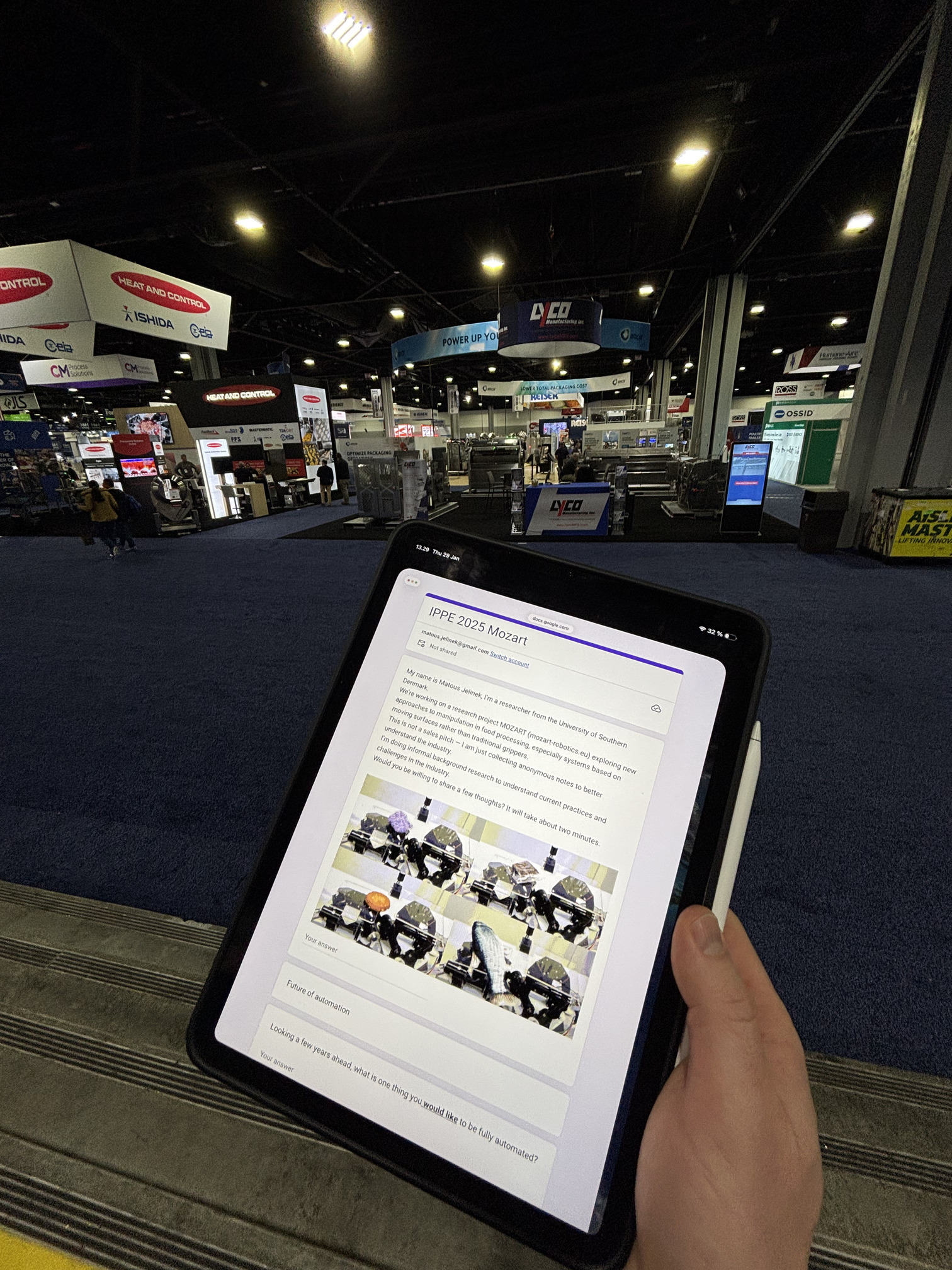
I carry a tablet with a brief glimpse of MOZART, our morphing robotic surface, and ask anonymously simple questions such as: what would it take for something like this to work in practice? The answers are rarely dramatic. They are practical, grounded. Here, I am not at the academic conference. “They are very practical and sales-oriented people,” shares our industry contact before the show about the crowd around us.
“Well, we have been implementing some of what you call AI… But for us, it was a black box. And we need to have things under control,” one person shares carefully.
The tension between new approaches and existing technology becomes even clearer in one of the early-morning sessions focusing on AI in the industry. The room is full, people have come early, coffee in hand, to hear about the future. And the speaker opens up his talk with a sentence that resonates immediately: “Many of you are here because of the fear of missing out. Everyone is talking about AI, and that creates pressure.” The room is silent. Then people start sharing that they keep exploring options, but are unsure where to start.
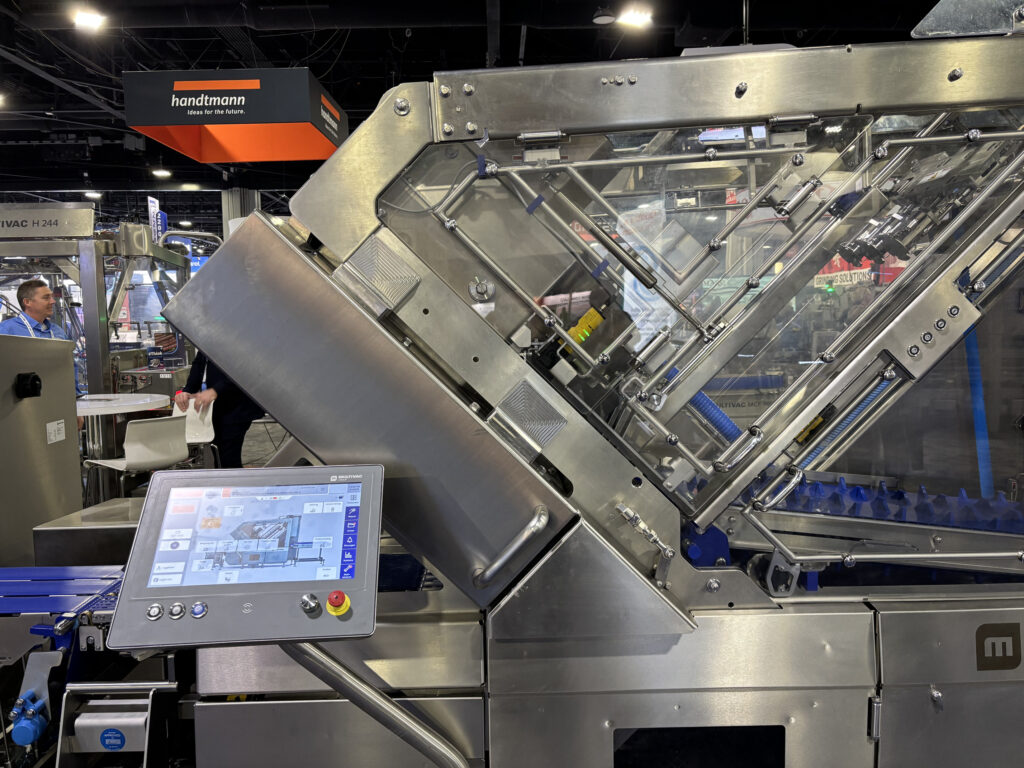
Polished machinery on display at IPPE.
And this is also what I saw on the expo floor: “AI” is present in many of the booths: it improves thermomanagement in production halls, helps to optimize this and that,… But the session moves away from the hype. “What we often see is that companies buy something that no one is using in the end. They don’t have the right partner. They don’t have the data we need to start. Their priority is shipping the product out of the door, not treating clean and consistent data infrastructure,” is what the presenter says, of course, representing a company that comes to offer some help.
What It Takes to Make it Work
What I hear again and again in conversations with exhibitors and visitors is that new technology, whether a production line, packing line, or a tool making fake burn marks on a chicken breast, is never just a machine. It is a promise: of uptime, of service, of someone picking up the phone when production cannot wait at 2 am. “Great equipment is only half the story,” adds another person whom I interviewed. Third, a manager with 10+ years of experience puts it even more plainly: “You know, even if there is new technology that worked well, what customers want is not a solution, not just a product”. So what is it, then?
The nearly thirty conversations I had all pointed in one direction: relationship is the key, and technological readiness is largely assumed. “You need a trustworthy partner.” “You need to build a relationship.” These words resonate in the long halls of IPPE. Another participant, also with years of experience, puts that in a more business language: ”Vendor stability, service contracts, warranty. If it is a prototype that disappears, we can’t buy it.”
At the same time, none of this means the industry is resistant to introducing additional automation – such as our MOZART solution. “If you can replace some of the tasks done now by hand… then I think, yeah, why not,” one participant tells me. “There is always a lack of people willing to work in those super cold conditions,” she adds. Another participant places that same impulse into a much larger history of technological change: “First we had fire, a stick, steam, internet, now AI, and I am waiting for the next big thing.”
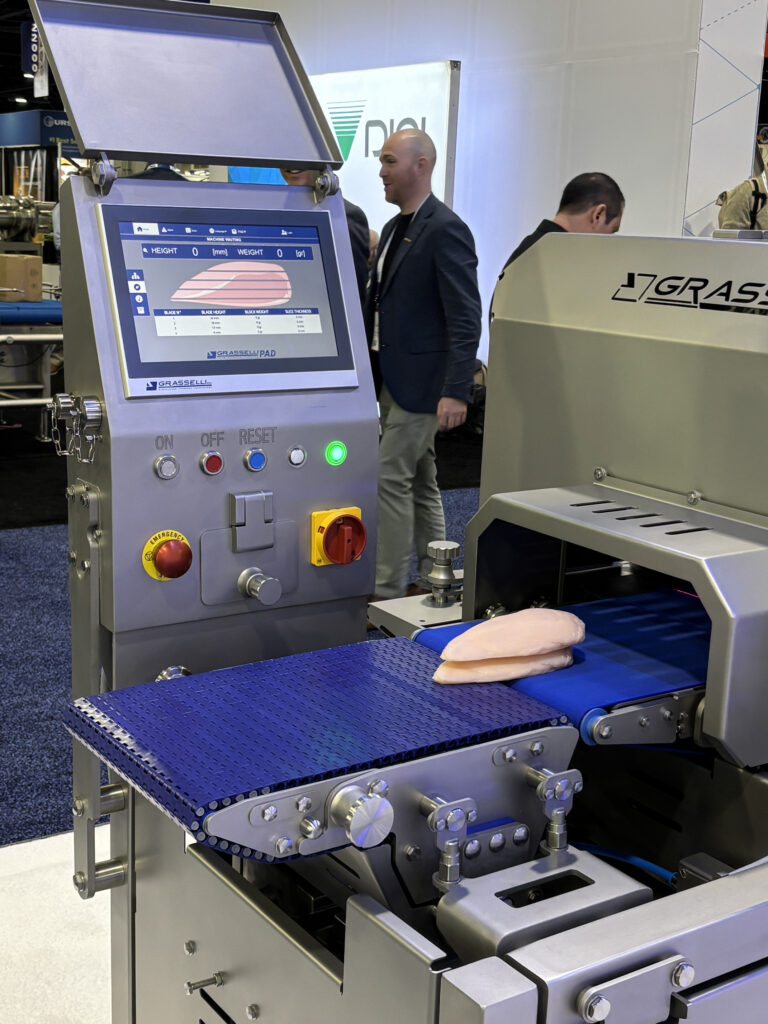
Another example of advanced technology presented at the expo, where efficiency and precision are the key to success.
“The most important thing we build is trust,” sounds the claim on one of the booths. I approach the stand and ask one of the sharply dressed representatives to clarify what it means to them and their customers: “Dependability and service. You need to be there if your customers need you,” sounds the reply.
That may be one of the biggest barriers for any new technology entering this hall. Trust is not just an option; in this highly regulated, competitive, and effect-oriented industry, it is part of the infrastructure. New technology enters through reliability, service, and relationships, strong enough to outweigh the risks of novelty.
I have interviewed a few dozen IPPE participants in Atlanta, and I will say more about these conversations in the future. But already here, between the stainless-steel lines and endless carpets, one thing becomes clear: the question is not simply whether a system can automate a task. The real question is what it takes for that system to survive in practice. And that is exactly the kind of question(s?) the SSH team of MOZART is exploring.