


Materials, shapes and movements of soft robotics. Journey through MOZART’s robotics labs, pt 2
In which we explore how different common objects can illustrate the properties and functions of soft robots.
MOZART’s social sciences and humanities team embarked on a journey across our partnering robotics labs to find out all about soft robotics. We learned that soft robotics is not only based on innovative engineering solutions, but also establishes new relationships between humans and machines, and between nature and technology. During our visit to MOZART’s robotics labs, we organised an interdisciplinary workshop to creatively explore different ways to define and describe soft robotics. The workshops were conducted by Ginevra Sanvitale. In this new series of posts, we present the results.
Having defined what soft robotics is through words and concepts, we moved to the dimension of materiality. The second workshop activity focused on exploring properties of soft robotics that could be found in normal objects. The SSH team collected a set of items that reminded us of soft robotics, based on what we learned during our conversations with MOZART engineers, and through their presentations in consortium meetings. We then presented these objects to the robotics labs, asking workshop participants to evaluate if and how they could evoke properties of soft robotics. In engaging with soft robotics as more than a technical domain, our interdisciplinary workshop enacted a new feminist materialist approach to knowledge production (Haraway 1988, Barad 2007). By using everyday objects to evoke properties of soft robotics, we moved away from rationalist or purely functional framings, and toward tactile and sensory ways of knowing. This approach further echoes feminist HRI’s emphasis on relational design, embodied engagement, and inclusive, interdisciplinary collaboration (Suchman 2007, Gemeinboeck and Saunders 2023). Exploring soft robotics through touchable, familiar objects and collaborative discussion produces knowledge that is co-constructed and experiential.
The first set of objects included items that reminded us of soft robots because of their texture and deformability. These were: a face mask (1), a chenille “twisty worm” (2), jute (3) and felt coasters (4), a mesh bag (5).
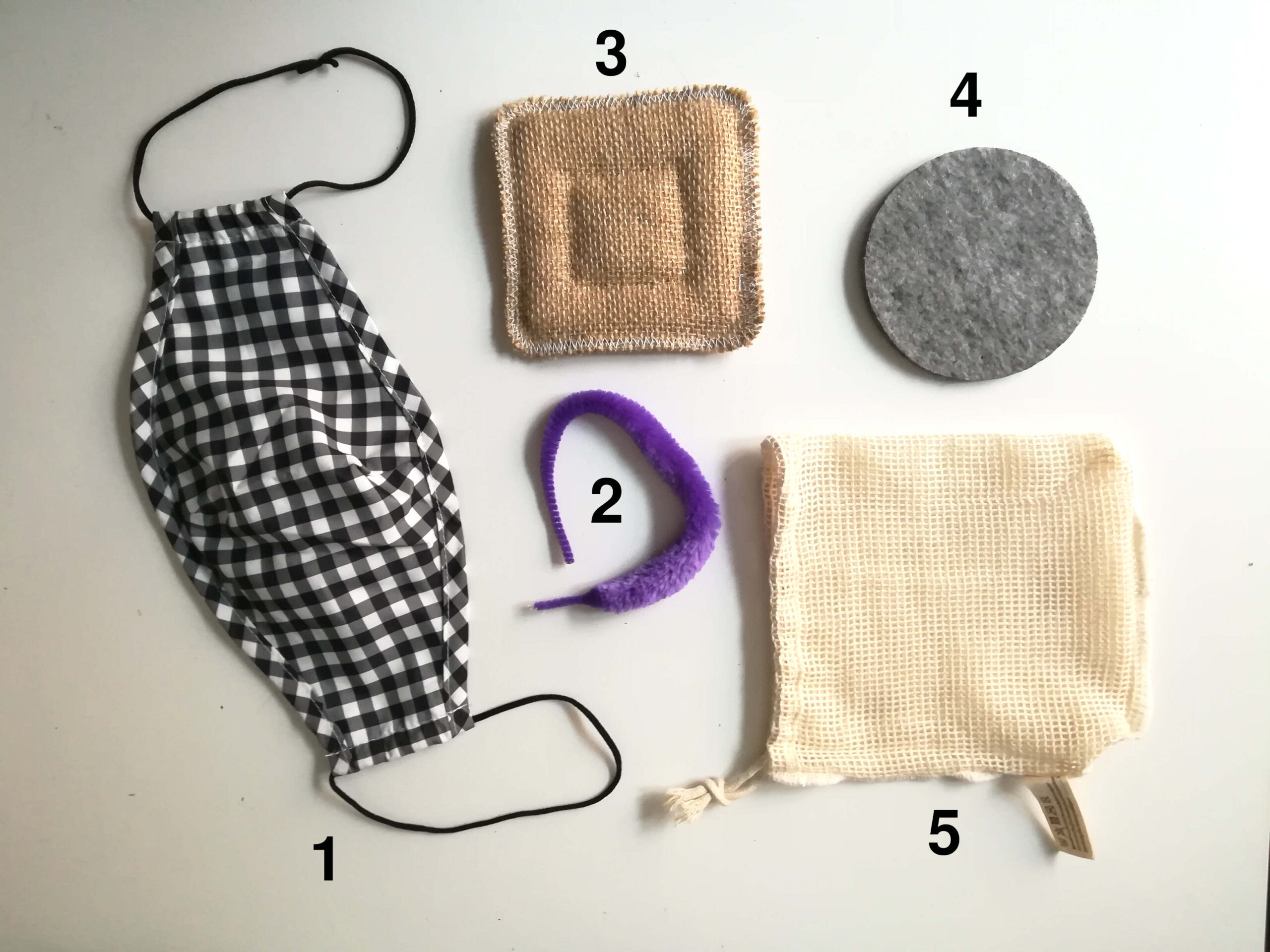
The twisty worm (2) was pointed as the best example among the objects when thinking about soft robotics. Its form resembles a snake or tentacle robot, and it has high flexibility, with a soft (although arguably too fluffy) texture. Its structure suggests potential applications such as acting like a propeller if one extremity is fixed. In contrast, the face mask (1) is arguably the worst example in this group. Despite its softness and deformable structure it lacks stretchability, which is a crucial trait in soft robotics. However, it does spark some metaphorical and practical ideas: the “mask layer” can be likened to layers in soft robotics, and textiles from masks could be integrated into soft robot designs. Additionally, sensors might be embedded in such a form.
The felt coaster (4) presents another low-relevance example. It is soft to the touch, but lacks both structural integrity and functionality. However, it might play a conceptual role in soft robotics, perhaps as a sensing layer or a base to create actuators with varying responses. The jute coaster (3) brings to mind pouch actuators and shape memory actuators — both important components in soft robots. Its coarse texture highlights an important point: softness in soft robotics is not solely about tactile experience. Rather, it can also relate to deformation, structure, and functionality. This object maintains a good structural form, making it more relevant to soft robot applications than it might first appear. Finally, the mash bag (5) is interesting for its visual and conceptual qualities. It lacks structural firmness but features a good surface pattern, reminding of how MOZART surfaces move and deform. Functionally, it could serve to enclose objects, similar to how some soft robotic components operate.
The second set of objects included items that we associated with soft robotics because of their structure and movement. These were: a fan (1), post-its (2), a balloon (3), hairbands (4), candle wax (5), rubbers (6), a paper garland (7).
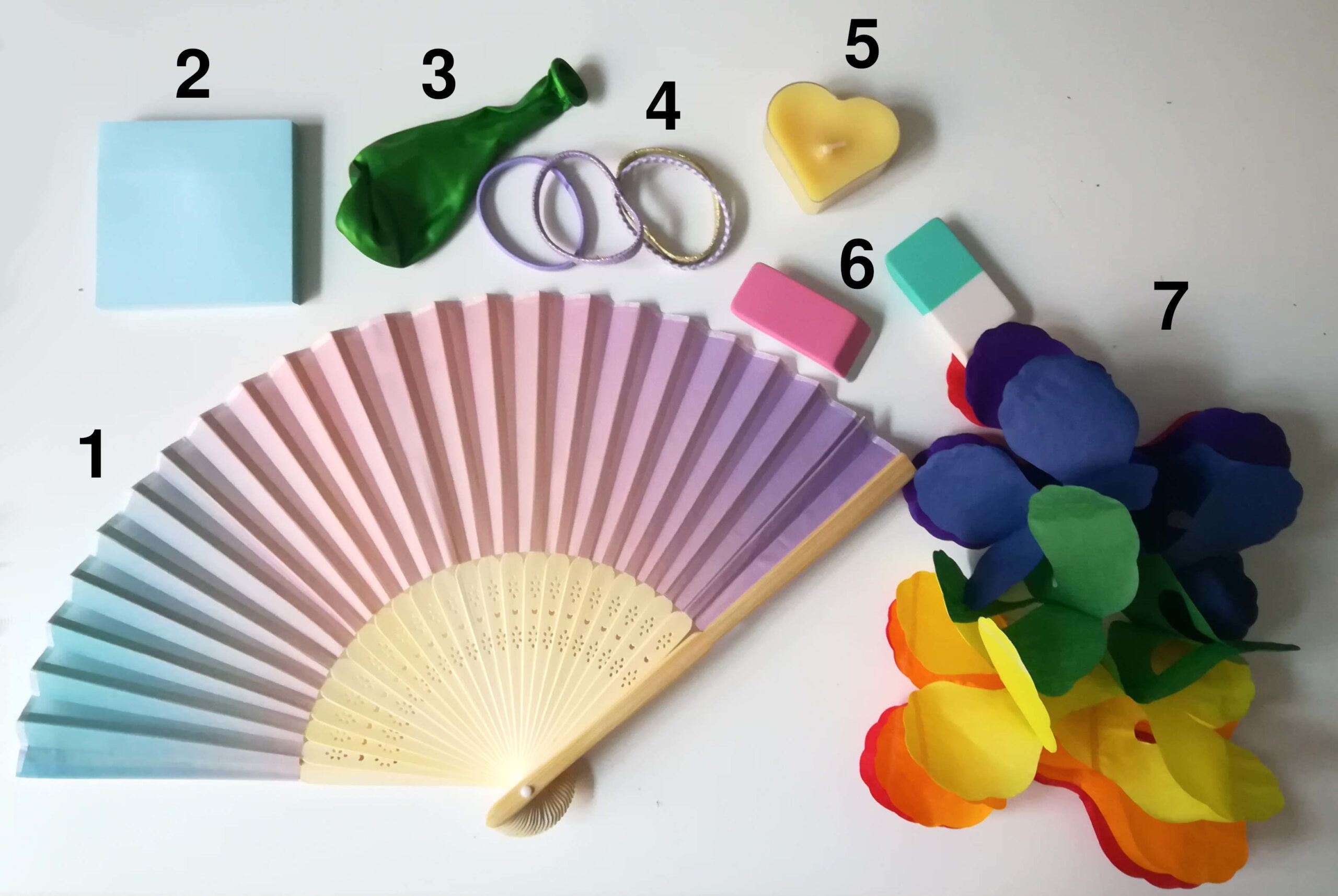
The paper garland (7) stands out as a fitting example, according to multiple workshop participants. Flat when at rest and animated when unfolded, it captures the spirit of soft robotics through movement, transformation, and adaptability. Its many degrees of freedom exemplify the characteristics of inchworm or cable-driven robots. Another compelling example is the balloon (3), as it exemplifies one of the most used actuation mechanisms in soft robotics. When inflated with air, the balloon transforms from a limp object into a more rigid, structured form, making it a prime example of how soft materials can shift properties under pressure. Post-its (2) offer surprising potential as soft robotic analogs. Their layered structure and reconfigurability foster creative interpretations—such as being folded accordion-style or rearranged into garlands. Moreover, the first step of a robot design process often begins with folding a piece of paper, and Post-Its embody that moment of conceptual exploration. The fan (1) proved to be a rather controversial item. While praised by some participants as the best soft robot example due to its design and movement properties, according to others it ultimately leans more toward the realm of origami robots or traditional robotics, as the overall mechanism is too structured and inflexible to be considered a true soft robot.
Rubbers (6) are composed of heterogeneous materials, but despite this internal complexity, they lack the essential qualities of a soft robot. Referred to as “a rigid object in disguise” by one participant, the rubber fails to meet the flexibility and responsiveness that characterise soft robots, standing as one of the less relevant objects. Hairbands (4) do not offer direct examples of soft robots features, but they capture the essence of basic robotic motion—storing energy and releasing it to generate movement. Their flexibility surpasses that of rubbers, though they still fall short in terms of adaptability. They can be related to soft robotics not as complete systems, but as critical building blocks. For example, they can be repurposed as rolling loop mechanisms, to obtain dynamic motion. Candle wax (5) evokes the world of molding and transformation, hinting at the manufacturing processes used in soft robotics. It shares similarities with shape-memory materials that change form when heated and then retain their new shape. In this way, it brings to mind wax actuators, though in a much more rudimentary form. As a soft robot, candle wax falls short due to its unidirectional, highly predictable motion. This item is perhaps better categorised under “unconventional” or “deformable” robotics.
Exploring these everyday objects through the lens of soft robotics reveals the complexity and nuance in defining what truly makes a robot “soft.” While softness is often associated with material properties, it becomes clear that softness in robotics is not always literal. In fact, some soft robots can be made of relatively rigid materials, yet still exhibit “softness” through structural design or controlled movement. This highlights an important distinction: softness is not only determined by what something is made of, but also by how it behaves and interacts with its environment. Moreover, as observed throughout the workshop, we can induce “soft” characteristics by altering a material’s configuration. A simple act—such as cutting a hole into a structure—can transform an otherwise rigid object into something that flexes or deforms in a useful way. This reinforces the idea that softness is often a result of intentional design intervention rather than material selection alone. It is not a fixed property, but a multifaceted concept shaped by both engineering creativity and functional aims.
Ginevra Sanvitale
References
Barad, Karen. (2007). Meeting the universe halfway: Quantum physics and the entanglement of matter and meaning. Duke University Press.
Gemeinboeck, Petra and Rob Saunders. (2023). Dancing with the nonhuman: A feminist, embodied, material inquiry into the making of human-robot relationships. In Companion of the 2023 ACM/IEEE international conference on human-robot interaction (pp. 51-59).
Haraway, Donna. (1988). Situated Knowledges: The Science Question in Feminism and the Privilege of Partial Perspective. Feminist Studies, 14(3), 575–599.
Suchman, Lucy A. (2007). Human-machine reconfigurations: Plans and situated actions. Cambridge University Press.