

The making of a soft robot. Journey through MOZART’s robotics labs, pt 3
In which we try –and fail– to build soft robotics prototypes.
MOZART’s social sciences and humanities team embarked on a journey across our partnering robotics labs to find out all about soft robotics. We learned that soft robotics is not only based on innovative engineering solutions, but also establishes new relationships between humans and machines, and between nature and technology. During our visit to MOZART’s robotics labs, we organised an interdisciplinary workshop to creatively explore different ways to define and describe soft robotics. The workshops were conducted by Ginevra Sanvitale. In this new series of posts, we present the results.
The final workshop activity during the lab visits was meant to develop a soft robotics prototype, using the objects and materials from the previous activity and a Meccano-style metal construction set. Participants were instructed to freely tinker with the materials, working either in a group or individually. They were allowed to permanently alter the objects from the previous workshop, e.g., by cutting, piercing, blowing, or breaking them. Ultimately, the task was much more complicated than expected and few prototypes were built –but the activity was nonetheless useful to understand how a soft robot is made, and why it could not be made with the provided materials. Drawing again on new feminist materialism and human-robot interaction (HRI), the activity revealed that building a soft robot is not a linear or purely technical task. Instead, it involves an ongoing negotiation between human intention, material agency, and environmental context. As participants struggled to shape prototypes from everyday objects, the workshop highlighted the relational and often unpredictable dynamics at play in robotics development—thus showing the importance of process, collaboration, and embodied engagement in the design of more responsive, human-centered technologies.
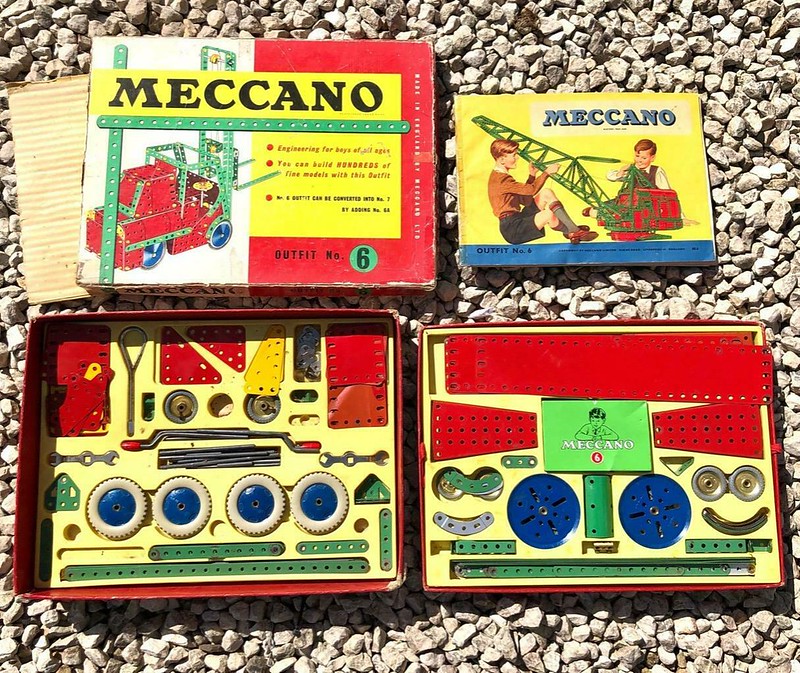
An old Meccano kit (picture by Gary Higgins, License CC-BY-NC-SA 2.0)
Of the few prototypes which were actually created, none was deemed a “pure” soft robot. Rather, they could be considered as “hybrid” robots, according to participants. The most functional one, pictured below, consists of two mechanical arms connected by a paper garland, forming a flexible, responsive structure. The arms are capable of opening and closing in a controlled manner, and as they extend outward, they stretch the garland. The garland acts as a soft, passive actuator because its materiality allows it to deform easily in response to external forces. When exposed to environmental stimuli such as wind or airflow, the garland exhibits dynamic movements, resulting in a mechanically responsive system. This design demonstrates how minimal actuation and simple materials can be combined to explore environmentally interactive behaviour, relevant to applications in responsive architecture or adaptive sensing systems. However, participants pointed out that this creation is more akin to an origami robot than a soft robot, because it uses foldable materials, relies on structural reconfiguration rather than material elasticity, and emphasises passive, environmentally responsive movement rather than active, compliant actuation. Nonetheless, the prototype conceptually overlaps with soft robotics in its flexibility, non-rigid design, and interactivity with the environment.
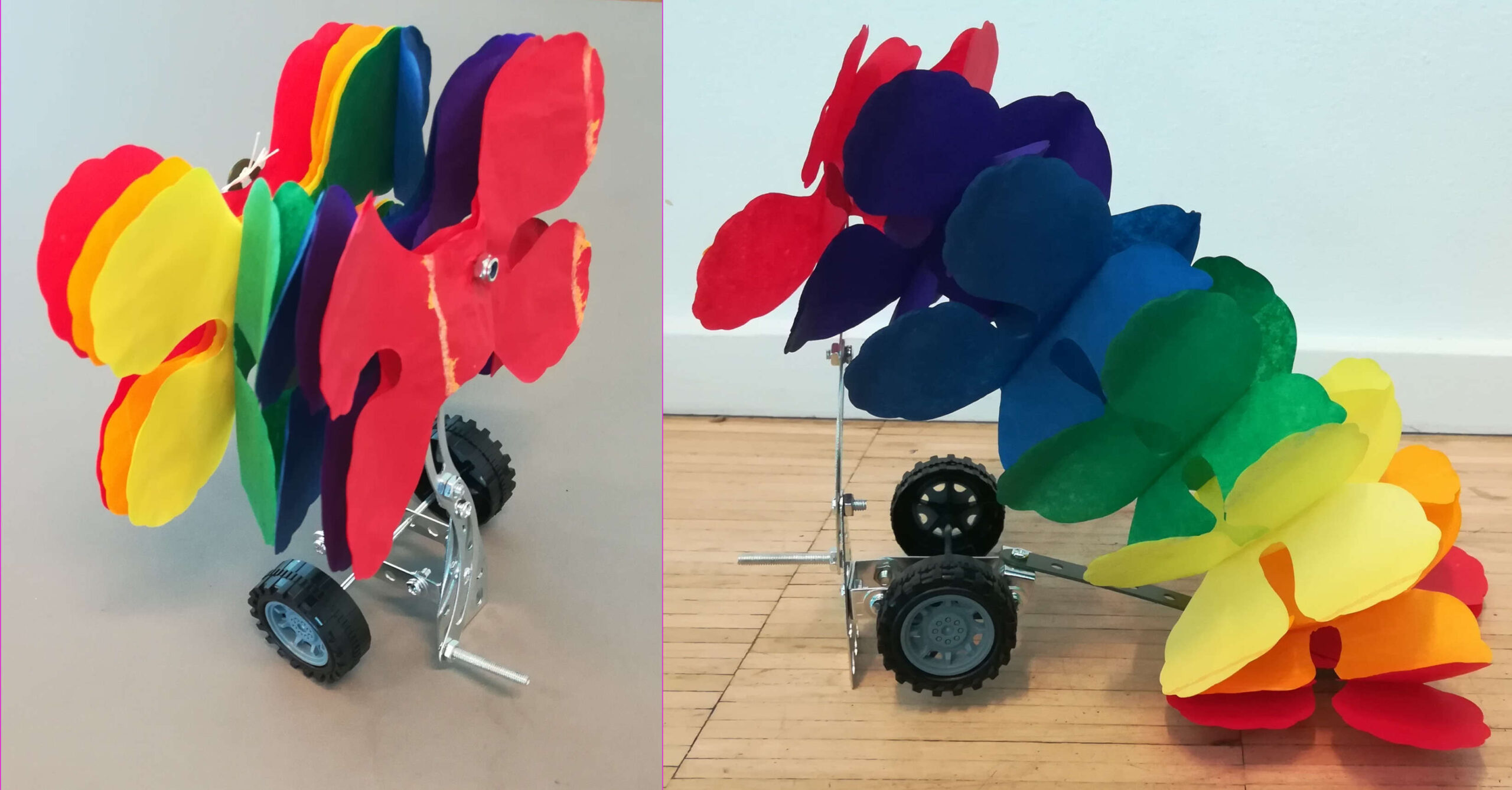
Our hybrid robot prototype
But why was building soft robots with the provided materials so complicated? As one workshop participants explained, there are several possible approaches to transforming a “traditional” robot –such as the one provided in the kit– into a soft robotic system:
- By constructing a conventional robotic structure and adding a soft outer shell for improved flexibility or interaction;
- By integrating soft robotic components that introduce new capabilities, such as gentle gripping or adaptive movement;
- By designing a transformable or deformable structure that fundamentally alters how the robot functions and interacts with its environment.
With the materials included in the activity, it was most feasible to create a hybrid robot, intended as a system that retains rigid elements but incorporates soft features for enhanced adaptability. Indeed, according to workshop participants, hybrid soft robots may represent the more practical direction for the near future, as they are easier to build and integrate with existing robotic technologies while still offering many of the benefits of soft robotics.
Other participants emphasised that a key obstacle was the lack of clear instructions regarding the specific tasks the robot was expected to perform, the purpose behind these tasks, and the broader setting in which the robot would operate. Central to the concept of soft robotics is the idea of compliance, the ability of a robot to adapt or yield when interacting with external forces. The choice of materials plays a vital role, as different soft materials serve diverse functions such as actuation, sensing, or adapting to the environment. But, importantly, soft robotics is not defined solely by shape or appearance: it encompasses much more than just the external form. As participants noted, soft robotics represents a design philosophy that integrates materials, control strategies, and fabrication techniques. It is less about adhering to strict criteria and more about adopting an attitude focused on creating systems that are adaptable, safe, and capable of responding effectively to the complexities of the real world.
The challenges that participants faced in understanding the robot’s intended purpose underscore a key insight from new feminist materialism and critical HRI: technologies are never context-free. From a new feminist materialist perspective, we can observe how the absence of clear instructions didn’t just hinder progress—it exposed the relational nature of design, where meaning and function emerge through the interaction of human intention, material properties, and environmental conditions. Similarly, in feminist HRI, the growing emphasis on situated, context-aware robotics challenges the idea of robots as autonomous, task-specific tools. Soft robotics, with its focus on compliance and adaptability, promisingly aligns with these views. This design philosophy exemplifies a shift from control toward co-evolution, reflecting feminist calls for more fluid, entangled, and ethically attuned relationships between humans and machines.
Ginevra Sanvitale
Bibliography
Barad, Karen. (2007). Meeting the universe halfway: Quantum physics and the entanglement of matter and meaning. Duke University Press.
Gemeinboeck, Petra and Rob Saunders. (2023). Dancing with the nonhuman: A feminist, embodied, material inquiry into the making of human-robot relationships. In Companion of the 2023 ACM/IEEE international conference on human-robot interaction (pp. 51-59).
Haraway, Donna. (1988). Situated Knowledges: The Science Question in Feminism and the Privilege of Partial Perspective. Feminist Studies, 14(3), 575–599.
Suchman, Lucy A. (2007). Human-machine reconfigurations: Plans and situated actions. Cambridge University Press.